Dr. Natalie Arnold, MD &
Cristian Riccio, PhD
Strong Together
Dr. Natalie Arnold, MD &
Cristian Riccio, PhD
Strong Together
At the Heart Clinic of the University Hamburg-Eppendorf (UKE), Natalie Arnold regularly treats patients who are struggling with the consequences of familial hypercholesterolemia (FH). This inherited lipid metabolism disorder leads to elevated low‑density lipoprotein (LDL) cholesterol levels, thus increasing the risk of cardiovascular disease such as heart attacks and strokes. The insidious aspect is that the effects of FH often develop unnoticed and are therefore usually diagnosed too late. This compelled Natalie Arnold, specialist in internal medicine and cardiology, to work more closely with Cristian Riccio, a bioinformation data analysist at Cardio-CARE. Their close collaboration focusing on FH was based on established structures of cooperation between the UKE and Cardio-CARE.
In a study, the two researchers investigated the prevalence of the disease and the correlation between genetically confirmed FH and LDL cholesterol levels. For the genetic analysis, Cristian Riccio used the genetic information of over 7,000 Hamburg residents from the Hamburg City Health Study. This data is part of the whole-genome sequencing project by Cardio-CARE and the UKE. Natalie Arnold provided medical oversight for the study. A key finding: the previously assumed close link between very high LDL cholesterol levels and genetic FH could not be confirmed. Only half of the participants with genetically confirmed FH had severe hypercholesterolemia with significantly elevated LDL cholesterol levels. Conversely, the vast majority with severe hypercholesterolemia did not have genetically confirmed FH. “This means that genetic screening programs, which are currently being discussed, are not yet sufficiently evidence-based for widespread use in the general population,” Natalie Arnold summarizes. Cristian Riccio adds: “Refraining from genetic screening would avoid unsettling individuals with genetically confirmed FH, since not everyone develops severe hypercholesterolemia. And of course, it also saves costs.”
In a follow-up study, both experts intend to further investigate the complex causes of this LDL cholesterol metabolism disorder. For Cristian Riccio, the FH study is proof that the Kühne Foundation is a key player in research: “Thanks to Cardio-CARE, we can address research questions directly relevant to patients.” Moreover, the genetic data allows for a wide range of analyses in cardiological research, for example, on hypertension or heart muscle problems. “This is a real treasure trove,” says Natalie Arnold. “After all, cardiovascular diseases remain the leading cause of death worldwide.”
“Thanks to Cardio-CARE, we can address research questions directly relevant to patients. After all, cardiovascular diseases remain the leading cause of death worldwide.”
Dr. Natalie Arnold &
Cristian Riccio, PhD
Cardio-CARE
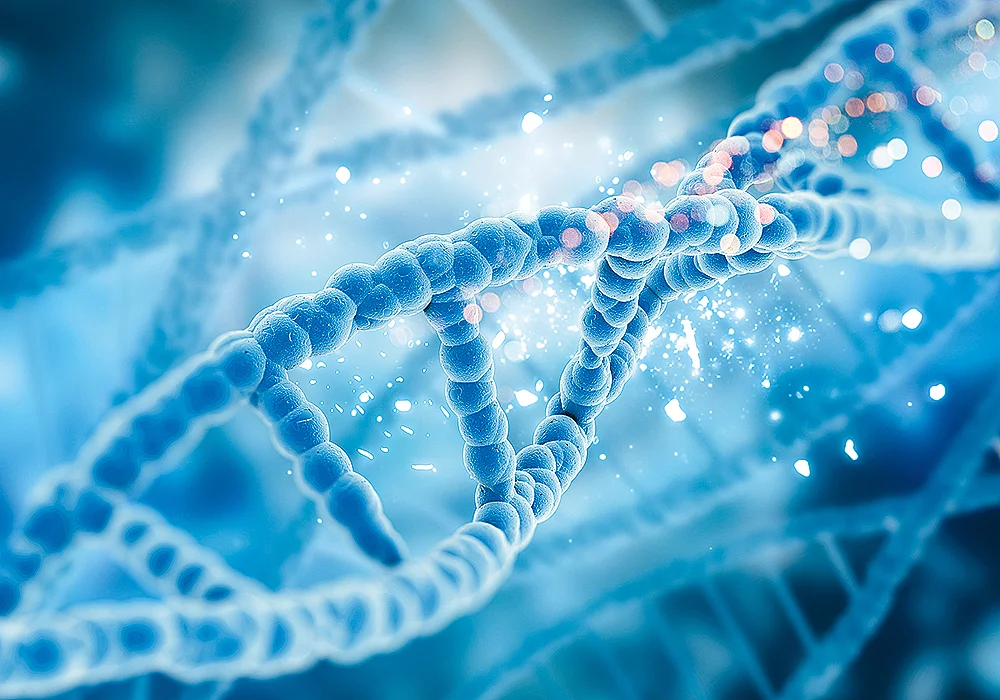
Founded in 2019 by the Kühne Foundation, Cardio-CARE strengthens the Medicine Campus Davos in data analysis with a focus on cardiology. Cardio-CARE is distinguished by the largest whole-genome sequencing project currently underway in the German-speaking world: together with the Department of Cardiology at the University Medical Center Hamburg-Eppendorf (UKE) and the Institute of Pathology at the University Hospital Zurich, Cardio-CARE has sequenced the genomes of over 9,000 individuals. The goal is to better understand and diagnose the genetic basis of cardiovascular diseases and to develop new treatment options.
Andrea Bembenek-Jaimes, Amina Djoudad & Steven Roche

Father Martin Werlen
Martina Russomanno & Tomislav Jukić